We Traded Ownership for Convenience: Sony’s End of Physical Games Feels Like the End of an Era
Opinion / Culture — REAL POWER.TV
A Millennial Gamer’s Reflection on What We’re Losing in the Digital Age
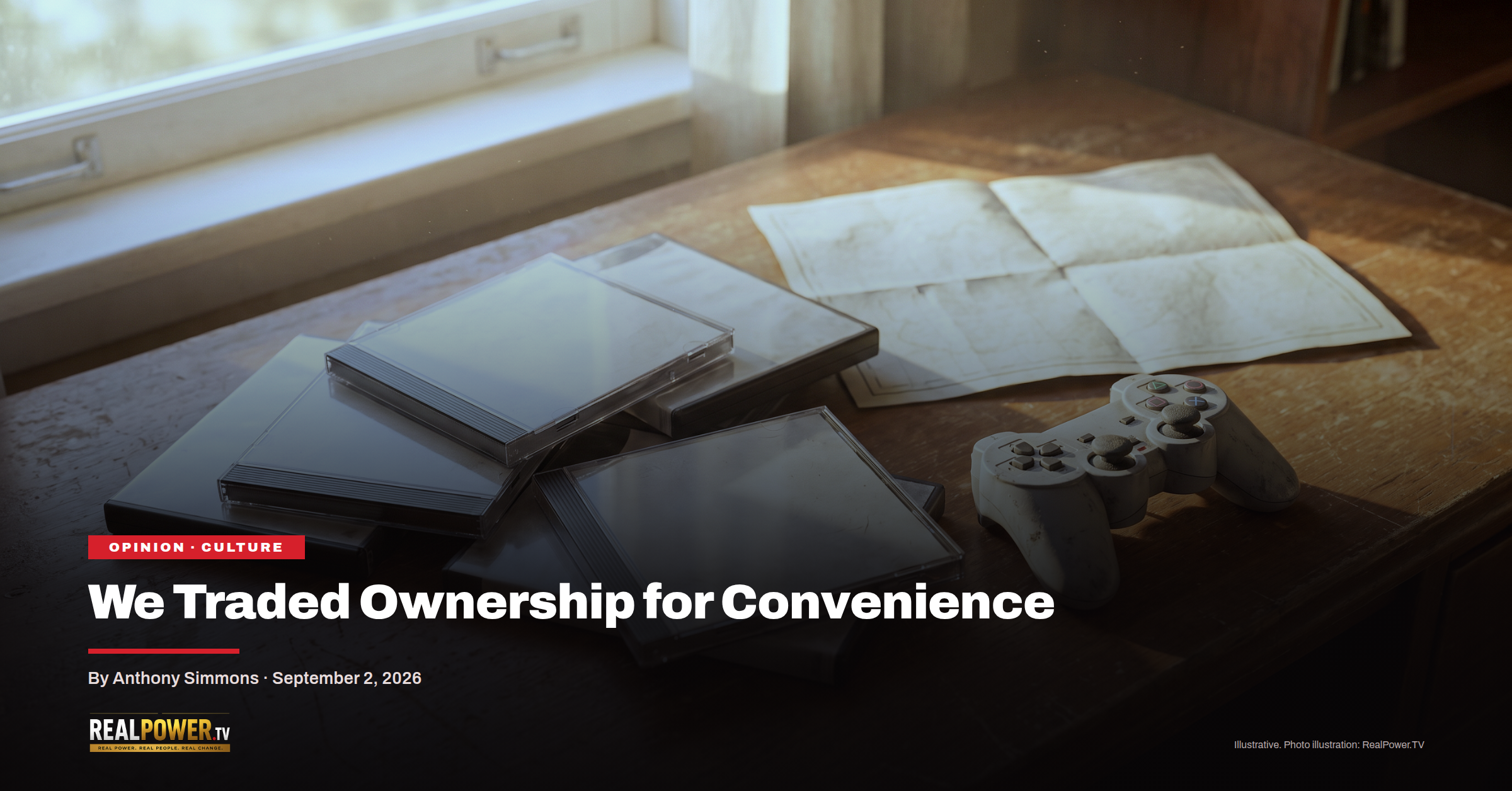
Somewhere in a box, I still have a map of San Andreas.
I don’t know exactly where it is. It’s probably folded up between other pieces of my childhood that I couldn’t bring myself to throw away. But I know it’s mine.
That map came with Grand Theft Auto: San Andreas, one of the defining video games of my generation. I spent countless hours in that world. After a frustrating day, I could turn on my system and disappear into Los Santos. I could drive around, explore, cause complete chaos or simply escape reality for a couple of hours.
But the game wasn’t the only thing that mattered.
There was something about physically owning it.
That’s why Sony’s announcement that it will discontinue physical game disc production for new PlayStation games beginning in January 2028 hit me harder than I expected.
I was sad. I was shocked. Then I became angry. Not necessarily at Sony. The company says it is responding to consumer behavior, and the truth is that physical media has been declining for years.
What shocked me was realizing that I might actually live to see physical video games disappear. Then another realization hit me.
My generation helped make this happen.
We Used to Make Buying a Game an Event
Growing up as a millennial gamer, getting a new video game wasn’t as simple as clicking “Download.” It was an experience. You read about games in Game Informer. You looked at screenshots. You talked about upcoming releases with your friends. Then came release day. Sometimes you went to GameStop. Sometimes you waited in line. You talked to complete strangers who were just as excited as you were. And special editions were actually special. I remember buying an NBA 2K Legend Edition with Kobe Bryant on the cover. Inside was a Kobe Bryant trading card and an NBA 2K Kobe poster. Those things weren’t necessary to play the game. That’s precisely why they mattered. They transformed a product into a memory. Game companies experimented with alternate covers, maps, posters, artwork, manuals and collector’s items. The physical package became another canvas for the people creating the game.
Today, I can still hold those things.
Twenty years from now, will I be able to say the same about a digital preorder bonus?
We Are Paying More and Owning Less
This is where my nostalgia becomes something more serious. Video games are becoming more expensive while our actual ownership of them becomes weaker. Think about that. I can spend $70 or more on a game and receive no disc. No case. No manual. No map. Nothing I can put on my shelf. Nothing I can lend to my friend. Nothing I can sell. Nothing I can hand to my future child. I receive access. And we’ve somehow convinced ourselves that access and ownership are the same thing. They’re not.
My definition of ownership is simple. If I own a basketball, I can take my ball to any park and play. I don’t need Nike to authenticate my account before tipoff. I don’t need Spalding to verify my subscription. I can let my friend borrow my ball. I can give it to my nephew. I can sell it. I can keep it in my garage for twenty years, discover it one afternoon and start playing again.
That’s ownership.
Physical games once gave us something close to that. Put the disc into another compatible system. Let your friend borrow it. Trade it. Sell it. Keep it. The digital future increasingly asks us to accept something different:
You paid for it, but someone else still controls it.
And Where Does This Stop?
Gaming is only part of what worries me. Look around. Music went digital. Movies went digital. Television became streaming. Software became subscriptions. Now gaming is moving further in the same direction. Where does it stop? Will there eventually be a generation that doesn’t buy DVDs or Blu-rays because studios stop making them? What happens when the movie you love moves from one streaming service to another? What happens when your favorite album disappears because of a licensing dispute? What happens when the game you’ve been playing requires a subscription you can’t afford that month? We are slowly building a world where entertainment never truly belongs to us.
You don’t buy.
You subscribe.
You don’t own.
You access.
And if you stop paying, the access stops too. I don’t want that future.
Millennials Have to Admit We Helped Kill It
But I can’t put all of this on Sony. That would be dishonest. Millennials have to admit something uncomfortable: We helped kill the things we’re now nostalgic for. We wanted MP3s because CDs were inconvenient. We wanted streaming because DVDs took up space. We wanted Amazon because going to the store took too long. We wanted digital games because who wants to drive to GameStop when the game can download at midnight? Convenience won. And then something strange happened. We got older. Now millennials are buying vinyl records. We’re collecting old game systems. We’re buying Pokémon cards again. We’re searching for physical copies of games we played twenty years ago. We’re building bookshelves. We’re collecting movies. Why? I think somewhere along the way, we realized something.
Physical things have meaning.
A vinyl record isn’t merely a less convenient Spotify.
It’s artwork. It’s liner notes.
It’s something an artist designed for you to experience.
The same is true of games. As I’ve gotten older, I’ve learned to appreciate the art behind the object itself. Convenience gave us instant access to almost everything. But somewhere in that transaction, we lost something too.
We Lost Community
There is another part of physical gaming that we don’t talk about enough. We lost spaces. A midnight release wasn’t only about getting the game. You were standing outside with people.
Talking.
Debating.
Laughing.
Meeting people who loved the same thing you loved. The internet supposedly connected everybody, yet sometimes I wonder whether we’ve ever been more isolated. You don’t need to leave your house anymore. You don’t need to talk to the person standing next to you. You don’t even need to see another human being.
Click.
Purchase.
Download.
Play.
Efficient?
Absolutely.
But efficiency isn’t always community. I want my future children to experience spaces where people gather because they’re excited about something. I want them to know what it’s like when a game release feels like an event rather than another notification appearing on a screen.
The Used Game Market Wasn’t Perfect Either
I’m not going to romanticize everything about physical gaming. Anyone who grew up shopping at GameStop remembers the pain. Buy a game for $60 on Monday. Come back a week later.
“Best I can do is $5.”
We complained about it constantly. But here’s the funny thing: At least I could sell it. I had an asset. Maybe GameStop’s offer was terrible, but I had the option to say no and sell it somewhere else. I could give it away. I could trade with a friend. Digital media eliminates much of that secondary economy. And as physical production disappears, I’m worried we’re going to see the remaining physical games become increasingly expensive collectibles. Collectors know exactly what happens when supply becomes finite. People buy copies not because they love the game, but because they know somebody else will eventually pay more for it. Suddenly preservation becomes speculation.
We Need Digital Ownership Rights
I’m not arguing that technology should stop. I’m not asking Sony to pretend it’s 2004 forever. Digital gaming is convenient. I use it too. But technological progress shouldn’t require consumers to surrender ownership. If physical media is going to disappear, then our laws and consumer protections need to catch up with the digital world. If I purchase a game, there should be meaningful protections allowing me to continue accessing that game. Companies should clearly distinguish between purchasing something and licensing temporary access to it. We should also find ways to preserve video games as cultural works. And I believe companies should continue producing physical collector’s editions for people who want them. Give consumers a choice. The future doesn’t have to be physical or digital. There should still be room for both.
I Keep Thinking About My Future Kids
That’s ultimately why Sony’s announcement bothers me so much. I don’t have children yet. But I think about them. I think about the world they’re going to inherit. And I don’t want my kids growing up in a world where they don’t own anything. A world where their games require subscriptions.
Their music requires subscriptions.
Their movies require subscriptions.
Their software requires subscriptions.
Their entire digital life becomes another monthly bill that never ends.
Work.
Get paid.
Pay the subscriptions.
Repeat.
That’s not technological freedom to me. That’s renting your life. Maybe one day my kids will find my old San Andreas map buried in a box. They’ll probably laugh at me.
“Dad, why did you keep this?”
And I’ll unfold that old map and tell them about Los Santos.
I’ll tell them about Game Informer.
I’ll tell them about walking into stores and looking at walls covered with games.
I’ll tell them about special editions and posters and trading cards.
I’ll tell them about standing in line with strangers who were just as excited as I was.
And maybe they’ll think all of it sounds ancient. That’s okay. Because I’ll still be able to put that map in their hands. Twenty years later, it will still be mine.
No password.
No monthly payment.
No server.
No subscription.
No corporation deciding whether I’m still allowed to access it.
Mine.
I can take my ball to any park and play. Maybe physical media was always going to fade away. Maybe Sony is simply acknowledging where consumers have already taken the industry. But before we celebrate another step toward our completely digital future, my generation should think carefully about what we’ve traded to get here. We traded permanence for convenience. We traded community for efficiency. And increasingly, we’re trading ownership for access. I don’t want my childhood back. I don’t need the world to stop changing. I just don’t want my future children to inherit a world where everything they love comes with a monthly payment attached to it.
Because millennials grew up buying things.
Our children may grow up buying permission to use them.
And I’m not convinced that’s progress.
Anthony Simmons · Cleveland, Ohio · September 2, 2026
REAL POWER.TV is Cleveland’s Black digital newsprint. We name who decided, what it costs you, and what comes next. Subscribe to the outlet at RealPower.TV.
REAL POWER.TV
The Story Runs Here First.
Cleveland’s Black digital newsprint. Who holds power here, who is losing it, and what the moves mean before anybody gets around to explaining them to you. Free, straight to your inbox.