
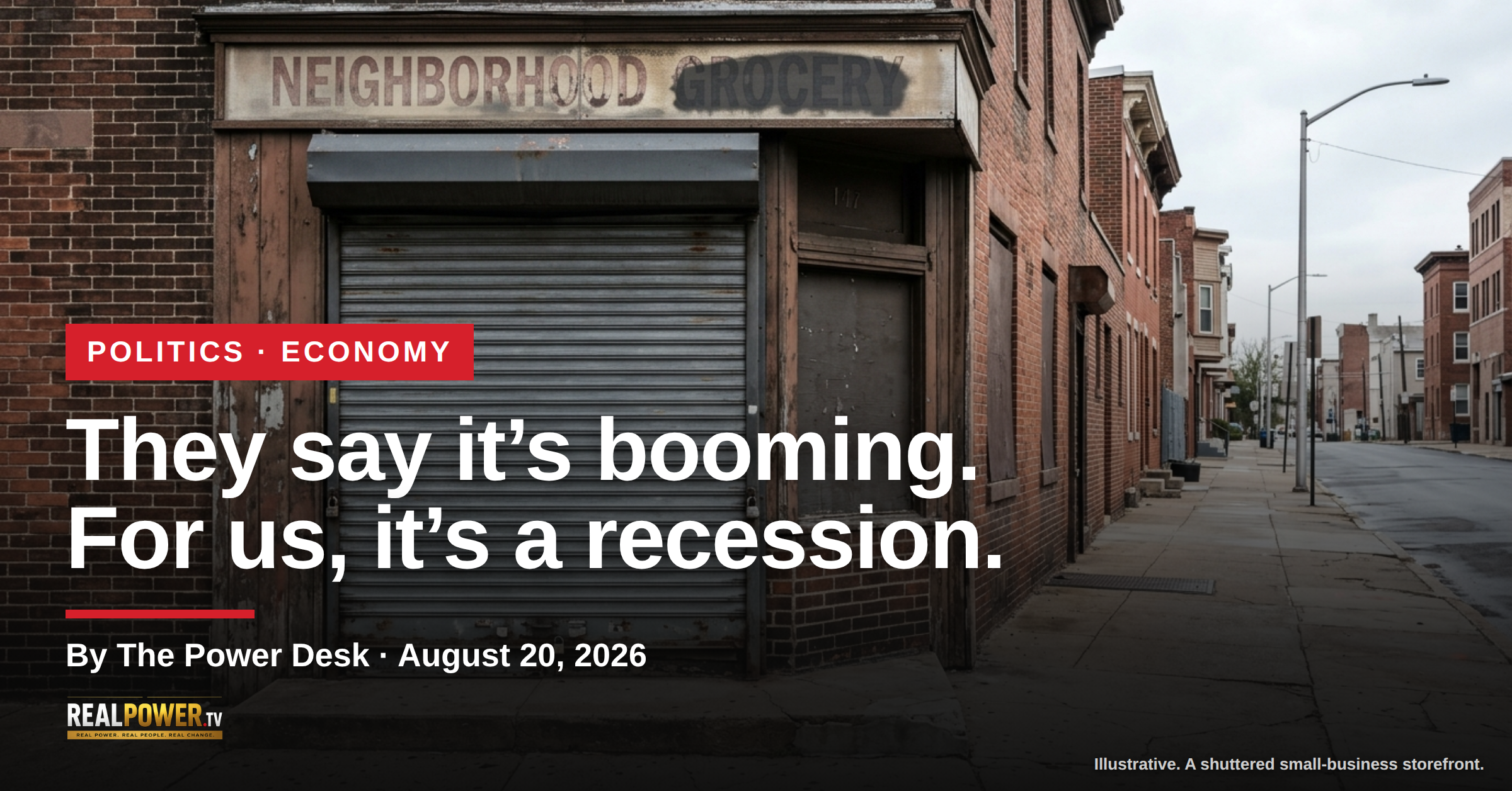
While Trump Says the Economy Is Booming, Black America Is Already in a Recession
By The Power Desk — a RealPower.TV analysis of Antjuan Seawright’s column in The Root. The reporting and the argument are his; the write-up is ours.
Talk of a coming recession has dominated headlines for weeks — rising insurance costs, waves of layoffs, families with six-figure incomes leaning on credit just to keep groceries in the house. But according to political strategist and Root columnist Antjuan Seawright, that framing gets the timeline wrong. For Black America, he argues, the recession isn’t coming. It’s already here. As National Urban League President Marc Morial put it recently, “For Black America, the recession has already arrived.”
The unemployment numbers tell the story. While the national rate sits near 4%, Black unemployment climbed to 6.6% in June — even as the administration touts strong outcomes for Black workers. Seawright traces much of that gap to the rollback of diversity, equity and inclusion programs across the private and public sectors: roughly 300,000 Black women lost their jobs in a single three-month stretch last year, and more than half a million Black men were pushed out of work between November and February. By his count, some 600,000 Black women remain unemployed today.
That instability lands harder because so few Black households have a cushion to fall back on. Nearly six in ten Black Americans don’t have enough savings to survive a layoff, compared to four in ten white Americans — and that gap only widens as prices climb at the pump, at the register, and everywhere in between. It’s a pattern that shows up in downturn after downturn: whatever bruises the broader economy tends to fracture Black America’s.
Healthcare is another pressure point. With federal subsidies under the Affordable Care Act allowed to lapse, insurance premiums have spiked, and Seawright cites survey data showing nearly 57% of Black Americans now say they can’t afford care. Layered on top of that are sweeping federal budget cuts — more than $500 billion pulled from hospitals and safety-net programs, including the largest reductions to Medicaid and SNAP in the country’s history.
Even foreign policy shows up in the household budget. Seawright points to the roughly $40 billion in added fuel costs Americans have paid since the administration’s strikes on Iran two months earlier — a hit that lands heaviest on communities that were already stretched thin before gas prices moved.
On housing and debt, the numbers keep piling up: foreclosures have climbed to around 18%, Black homeownership slipped to 43.9% in the first half of 2025, and national credit card debt has reached $1.25 trillion, with roughly 40% of cardholders unable to pay their balance off each month. Seawright notes, pointedly, that National Economic Council Director Kevin Hassett hasn’t sounded particularly alarmed — he’s pointed to strong earnings at the credit card companies as a sign the economy is fine.
Grocery prices posted their steepest one-month jump in four years this past April, and by Seawright’s math, a pound of ground beef now costs more than an hour at minimum wage. Meanwhile, he writes, the administration is working to wind down two of the federal government’s central supports for Black-owned businesses — the Community Development Financial Institution (CDFI) Fund and the Minority Business Development Agency (MBDA).
Seawright’s bottom line: the rest of the country may only now be catching the scent of an economic downturn. Black America has been standing in the smoke for more than a year. His column isn’t just a warning — it’s a call to stop treating the numbers as an abstraction and start treating them as a crisis that’s already here.
— Adapted from Antjuan Seawright’s column, “While Trump Says the Economy is Booming, the Reality Points to a Black Recession,” originally published by The Root, July 7, 2026.
Read Antjuan Seawright’s full column at The Root →