Not About Me
Commentary
Opinion / Community — REAL POWER.TV
Today was a tough day. Tough to the point where my head is still pounding as I write this, hours later, in the quiet that comes after everyone else has gone home and the adrenaline has finally started to drain out of my body.
I was sitting in my car, talking with a good friend, windows cracked, the kind of ordinary evening conversation that doesn’t ask anything of you. That’s when I heard it — commotion coming from the park across the way. Voices rising. The particular pitch that tells you something is shifting from talk to trouble.
Two young men, 14 or 15 years old, had gone from conversation to argument to slap-boxing to fists. I’ve seen that progression more times than I can count. It has a rhythm to it, almost predictable, right up until the moment it isn’t. And this time it wasn’t. One of the young men — a familiar face, someone I’d crossed paths with before — slid his gun under the bleachers in the middle of the fight. Whether he did it to keep it safe, to keep himself from reaching for it, or simply because he didn’t want it on him if things escalated further, I don’t know. But the sight of it did something to the other kid. Scared him, maybe. Angered him, maybe both. Before I fully processed what I’d seen, that young man had taken off running toward home to get his family.
I want to pause here, because in between all of this, I noticed something that I haven’t been able to shake since. Children. Running around the edges of the park, the way kids do, oblivious for a few more seconds to what was unfolding thirty feet away from them. Some of them couldn’t have been older than seven or eight. As I got out of my car and started walking toward the situation, I thought of them specifically — not abstractly, not as a statistic, but as actual small human beings who were about to be in the blast radius of whatever was coming next. That image sat in my mind the entire time I was in that park. Every decision I made in the next ten minutes was shaped, at least in part, by the fact that there were children present who had no understanding of what could happen and no ability to protect themselves from it.
A few minutes after the young man ran off, his mother and his sister — visibly pregnant — arrived. They came in hot, cursing and belittling the familiar-face young man in front of everyone, including those same kids who were still weaving in and out of the grass, still playing, still innocent in a way that felt almost cruel given what was building around them.
I got out of the car because my experience — and I mean that in the fullest sense, not just years lived but years survived — told me exactly how this could end. Death. Jail. Sometimes both at once, one leading straight into the other. I know that road. I have walked parts of it myself, and I will get to that.
As I walked into the middle of it, something else was moving underneath my instincts. I am a former city councilman. I am an activist. I grew up in this neighborhood — not adjacent to it, not visiting it, but of it. Some part of me believed, the way I’ve believed my whole career, that my voice and my presence would mean something the moment I stepped between two families on the edge of violence. That people would hear who was talking before they even heard what was being said.
Maybe it did mean something. Things did calm down, eventually, and I have to believe my presence played some part in that. But it didn’t feel that way in the moment. It didn’t feel that way at all. Both sides kept going back and forth with each other like I wasn’t even standing there. My name — a name I’ve spent years building trust and relationships around in this exact community — meant nothing to either of them in that park. Not in that moment, not with that much fear and adrenaline running through everyone’s blood.
I took that personally. I made it about me, when it had nothing to do with me and everything to do with the trauma we were all carrying — theirs, mine, the whole block’s. That’s a hard thing to admit, that a title and a track record of service can walk into a moment like that and simply not register, because the moment isn’t organized around who you are. It’s organized around fear, and fear doesn’t check résumés.
I walked into the middle of it and tried to calm everyone down anyway. I wasn’t there to take sides. I wasn’t there to referee who was right. I was there because somebody needed to slow the temperature down before it reached the point where slowing it down was no longer an option. The pregnant young woman turned her anger on me. She cursed me out, told me to mind my business, and threatened to call her brother to come “shoot us all up.” I responded, “That wouldn’t be good.” Half empathy, half threat. Even as the words left my mouth, I understood that I hadn’t fully cleared myself of the same energy I was trying to talk everyone else out of. In hindsight, I know exactly which half of that sentence was doing the talking.
The familiar-face young man felt disrespected by the whole exchange happening around him — his own confrontation, now being run by other people’s fear and fury — and he wasn’t about to be punked in front of a crowd, no matter what advice I was offering. And that’s the moment I started taking it personally in a different way. Why won’t they respect my voice? Why won’t they respect my presence? My pride, my ego, moved to the front of the line, right where it had no business being.
It’s a blessing that when the brother finally arrived, he was calm. Genuinely calm, not the surface-calm that’s really just the seconds before an explosion. Still — my training kicked in before he said a single word. I’ve spent enough time around security work, around reading rooms and reading people, that I clocked the gun on his hip the moment he stepped into the park. Both sides were armed now. Both sides had at least one person not thinking clearly. One woman was pregnant and screaming. One man — me — had only been home for about ninety days.
Side bar, because it matters to how I’m telling this: I wasn’t in a cell. That’s not the shape my time away took. But I was away from this world, away from this neighborhood, away from the freedom to simply get out of a car and walk toward trouble without consequence, and I came back into all of it only about ninety days ago. That distinction matters, but it doesn’t erase the deeper truth underneath it — I know what it costs to lose your freedom, in whatever form that loss takes, and I know how fast one bad night can take it again.
Ninety days is not a long time to fully recalibrate. It’s barely enough time to remember how to move through a room without feeling like everyone’s watching you, let alone enough time to rebuild every instinct you need just to exist safely back out here. When I got out of that car and walked toward two families on the edge of a gun-involved altercation, I wasn’t only a concerned man in the neighborhood, and I wasn’t only a former councilman trying to be useful. I was someone barely three months back into freedom, and I am currently on probation. One wrong situation — one moment where things tip a different way, where somebody points a finger at me instead of at the two families actually feuding, where a responding officer sees a Black man in the middle of an armed confrontation and draws the wrong conclusion — could send me right back to where I just left. That is not a hypothetical. That is the actual math I am doing every time I choose to step into something like this.
I am, in this exact moment, battling myself over that math. Putting myself in the middle of situations like this one is not a good idea for someone who just came home and is still on probation. I know that. I knew it standing in that park. And I still got out of the car, because some other part of me — the part that has spent years building relationships in this community, the part people know throughout this neighborhood as a peacemaker, the part that has walked into rooms far tenser than that park and helped people find their way back to calm — didn’t know how to stay in the car and watch.
So what is my position now? What should I actually be doing with the time I’ve been given back? What do I mean to a community I love this much, if my name doesn’t register in the moments that matter most — and is it time for me to stop sacrificing pieces of myself, pieces of my freedom, for people who show no respect for me, for their present selves, or for their future selves? I don’t have a clean answer to any of that tonight. I have a headache and a lot of unresolved feeling instead.
What I do know is that the time away changed me in ways that cut in opposite directions at once. It numbed something in me — some of the fear I used to feel walking toward danger, some of the hesitation that might have kept the old version of me in the car a little longer. And it sharpened something else — a clarity about what actually matters, about how fast a life can turn, about how much of what looks like toughness in a moment like that is really just unprocessed grief looking for somewhere to land. I came back from that time both less afraid and more aware of exactly how much I have left to lose. Both of those things were standing in that park with me tonight, pulling in different directions the entire time.
After tempers cooled — and they did cool, slowly, unevenly, the way a pot stops boiling once you actually pull it off the heat instead of just turning the burner down — both sides walked away safely. Nobody got shot. Nobody got arrested. The kids who had been running around the edges of the park the entire time never fully understood how close they’d come to being caught in the middle of something that would have followed them for the rest of their lives, whether they got physically hurt or not. Children remember gunfire in a park even when the bullets don’t touch them. It rearranges something in how safe they believe the world is.
I sat with that for a long while afterward — how a woman carrying the most fragile gift a person can carry could also be the one most blinded by anger and ego in that exact moment. She was protecting her brother. I understand that instinct down to the bone; it’s one of the oldest, most human instincts there is. But in protecting him the way she chose to, she was building a situation that could have hurt everyone standing in that park — including the children weaving between the trees, including her own unborn child, including a man barely ninety days home who had walked over there trying to stop exactly the kind of ending she was threatening to bring closer, and who had far more to lose in that moment than almost anyone else standing there.
When it was over, I asked the familiar-face young man to talk to me for a second. Just a second. I wanted to check on him, to make sure he understood what he’d almost walked into, to offer whatever I could offer. His answer was short: “I don’t want to talk to you.”
I had just put myself physically between him and real danger — put my freedom on the line, if I’m honest about the stakes — and that response lit me up. I walked away, and my anger grew with every step I took. I was taking his words personally, same as I’d taken hers, same as I’d taken the whole night personally almost from the moment I stepped out of the car. My mind kept circling back to the same question: after everything, why wasn’t there more respect, more gratitude, more acknowledgment of what I’d risked to be there? Why didn’t my name, my history, my years in that community mean anything to either of them in the moment it mattered most?
It wasn’t until later that night — headache still pounding, sitting in the quiet trying to make sense of my own reaction — that it finally clicked. This was never about me.
That young man wasn’t in any place to say thank you. He’d just had a gun surface near him mid-fight, his family screaming on his behalf, adrenaline still flooding a fifteen-year-old nervous system that hadn’t finished developing the tools to process any of it. His silence wasn’t disrespect. It was overload, plain and simple. Give a kid like that a week, maybe a month, and the shape of what he feels about that night might look completely different. But in the minute right after it happened, he had nothing left to give anyone, least of all a grown man he barely knew asking him to process out loud what he hadn’t even started processing internally.
And her rage — the pregnant sister’s rage — wasn’t really about me either. It was fear wearing the mask of fury, the same way it does for a lot of people trying to protect someone they love with the only tools they’ve ever been handed. Nobody teaches de-escalation in most of the places where these situations happen most often. What gets taught, generation after generation, is volume. Whoever’s loudest, whoever’s most willing to threaten the worst outcome, wins the moment, even if winning the moment means losing everything that actually matters. She wasn’t thinking about her unborn child in that instant. She was thinking about her brother, about loyalty, about not being the one who stood by silently while someone disrespected her family. I understand that reflex. I grew up around that reflex. I’ve carried that reflex myself, more than once, including — if I’m honest — for a few minutes in that very park.
What I walked into wasn’t really a fight between two teenagers. It was a snapshot of where we are as a community — young people who can’t see past what they’re feeling in the moment, willing to risk everything, including each other’s futures, for a feeling that won’t even survive the night. Regret is patient. It doesn’t rush anybody. It waits, fully formed, for people at sunrise, when the anger has burned off and all that’s left is the wreckage of what the anger cost.
I had to consciously change how I was carrying this by the time I went to bed. Not because what happened wasn’t serious — it was, and it deserves to sit heavy, on me and on everyone who was there. But because the lesson I needed to take from it wasn’t they didn’t respect me. The lesson was bigger than my ego, bigger than my name, bigger than whatever validation I was quietly hoping to receive for stepping into danger on behalf of people who didn’t ask me to and who, in the moment, didn’t even seem to know who I was.
The lesson was that a community carrying this much unprocessed pain doesn’t need my ego in the room, and it doesn’t need my résumé either. It needs my presence. It needs my patience. It needs someone willing to keep showing up tomorrow, and the day after that, even when nobody says thank you, even when the response you get is “I don’t want to talk to you,” even when a scared young woman threatens the worst thing she can think to threaten because it’s the only language that’s ever felt powerful enough to protect the people she loves.
I still don’t know exactly what my position is supposed to be right now, in this season, on probation, ninety days into a version of freedom I’m still learning how to carry responsibly. I don’t know how many more times I can afford to step out of a car and into somebody else’s danger before the math stops working in my favor. But I know what I mean to this community, even on the nights it doesn’t feel like it — because the same neighborhood that didn’t seem to hear my name in that park is the same neighborhood that knows me, has known me for years, as someone who shows up when things get hard. That reputation was built one moment like this at a time, long before I ever had a title in front of my name, and it will keep being built one moment like this at a time going forward, whether or not anyone says thank you in the moment it’s happening.
I think about those kids running around the edges of that park more than almost anything else from that night. They didn’t ask to be there for any of it. They were just playing, the way children are supposed to be free to play, in a park that was supposed to be safe enough for that. Part of what I was fighting for in those ten minutes — even with my own ego tangled up in the middle of it, even with my own freedom quietly at stake the whole time — was the simple right of those children to keep playing without ever knowing how close the ground beneath them came to shifting.
This isn’t a reflection of me. It’s a reflection of where we are. Ninety days home, still figuring out exactly what I owe this community and what I owe myself, and still, apparently, the kind of person who gets out of the car anyway. That’s not a burden I’m complaining about. It’s the reason I can’t stop showing up — even while I sit here tonight, headache pounding, honestly unsure if that’s wisdom or something I still need to unlearn.
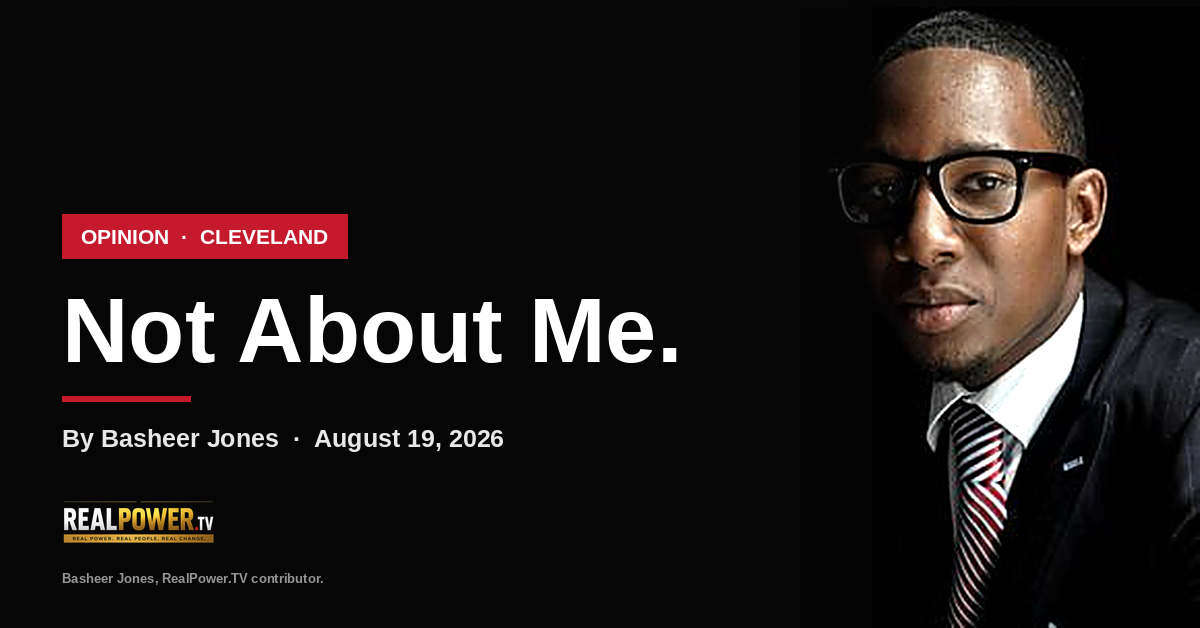
Basheer Jones writes for REAL POWER.TV.
REAL POWER.TV
The Story Runs Here First.
Cleveland’s Black digital newsprint. Who holds power here, who is losing it, and what the moves mean before anybody gets around to explaining them to you. Free, straight to your inbox.