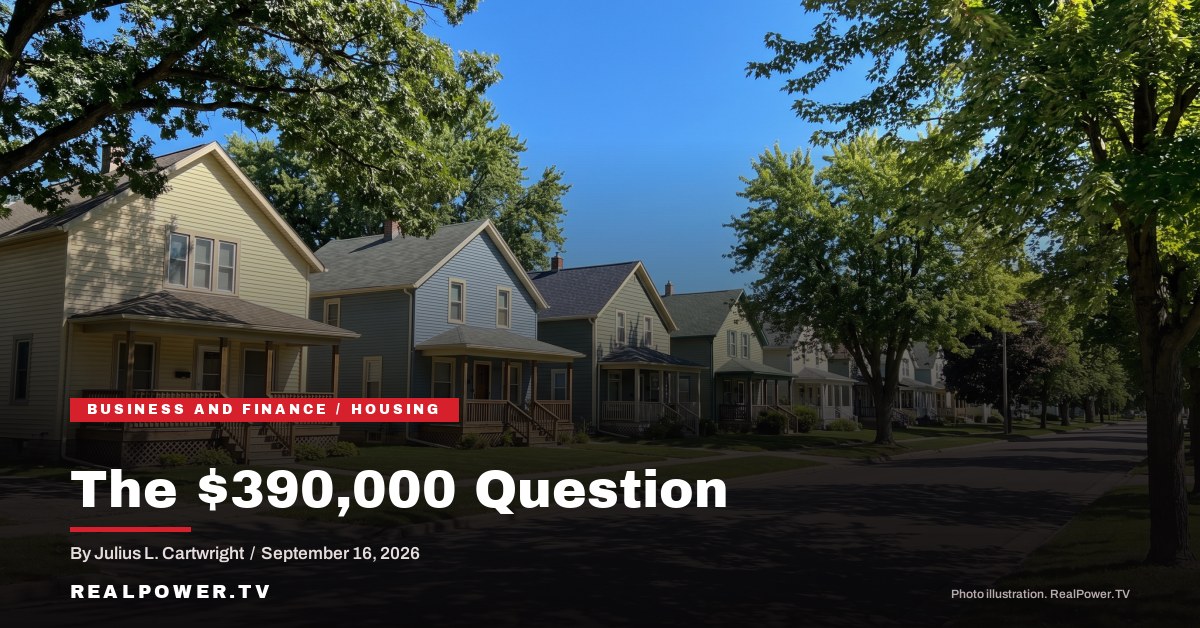
The $390,000 Question: Measuring the True Cost of Renting in Cleveland
Business and Finance / Housing — REAL POWER.TV
Part two of a series on buying in a market where the math still works
When we began this series, we established the structural reality of Cleveland’s housing market: a median sale price of $148,000 paired with a fast-moving inventory averaging 33 days on the market. It is a rare environment where a single income can still secure a deed. But recognizing an entry point is only half the equation. The other half requires looking at the ledger from the opposite side—measuring the exact, long-term financial cost of choosing to remain a renter.
Renting is often framed as the “safe” option because the monthly costs are predictable and capped. However, national wealth data reveals that the true cost of renting is not found in the monthly payment, but in the staggering loss of long-term asset accumulation.
The Homeowner-Renter Wealth Gap
When you look at the Federal Reserve’s Survey of Consumer Finances, the financial divergence between owning and renting is not just a gap; it is a canyon. In 2022, the median net worth for a homeowner was $396,200. For a renter, that number was $10,400.
That represents an overall median wealth gap of nearly $390,000 between those who own their living space and those who lease it.
The momentum of property ownership becomes even clearer when examining recent trends. The Urban Institute’s analysis of that same survey found that between 2019 and 2022, the median financial wealth of homeowners—the money that sits outside the house, in savings and retirement accounts—climbed from $60,000 to $85,000. Over that exact same period, renters’ median financial wealth flatlined, remaining stagnant at around $960. A net worth of under a thousand dollars provides almost no insulation against economic downturns, let alone a foundation for retirement or generational wealth transfer. Housing equity is the primary driver of that massive difference.
The Gender Divide in Home Equity
When we apply a gender lens to this data, the narrative becomes highly specific. Nationally, single women are already leading the charge. A LendingTree study released in January 2025 found single women owning roughly 11.14 million homes compared to the 8.42 million owned by single men. That represents a 2.72 million-home advantage.
However, the wealth distribution among women reveals distinct disparities based on household structure. Pew Research Center, working from the Census Bureau’s Survey of Income and Program Participation, broke it down in November 2024.
- Single women without children: This demographic has achieved a 50% homeownership rate nationally, holding a median home equity of $165,000. Their median wealth sits at approximately $87,200.
- Single mothers: The numbers tell a much harder story here. Only 34% of single mothers own their homes, and their median wealth drops to approximately $10,700. Yet, for those single mothers who do manage to break into homeownership, their median home equity is $114,000.
That $114,000 figure is critical. It proves that even when starting from a disadvantaged position, securing real estate fundamentally transforms a family’s balance sheet.
Deconstructing the Barriers
If the financial benefits are this stark, and Greater Cleveland remains one of the three most affordable major metros in the country—Redfin ranked it second-lowest of the fifty most populous U.S. metros in March 2026, at a metro-wide median sale price of $230,000—why aren’t more single women and mothers capturing this equity?
The hurdles are systemic, and acknowledging them is the first step to dismantling them. Married households generally accumulate substantially higher wealth simply because they can combine two incomes and pool resources. Buying alone means qualifying on one income, in a landscape where employed single household female heads earned about 88% of men’s median earnings as of 2019, the most recent year Pew measured.
Beyond the wage gap, women face major barriers including:
- Down payments and closing costs: Saving the initial cash required to close the deal remains a massive hurdle, particularly without a dual income.
- Debt-to-income constraints: Existing financial obligations, particularly student loans and credit cards, severely restrict mortgage qualification limits.
- Credit histories: Navigating the strict credit and debt-to-income ratios demanded by modern lenders.
- The absence of family wealth: Many buyers rely on family gifts or inherited wealth for down payments, creating an uneven playing field for those without access to financial assistance.
Mobilizing the Equity Movement
Understanding these barriers is exactly why targeted financial literacy frameworks are non-negotiable. This is the driving force behind Equity Smart is the New Cool and the broader Equity Movement 247. It is not enough to simply tell women to buy houses; we have to provide the structural scaffolding to get them to the closing table.
By leveraging the 4T resources, prospective buyers can systematically address their credit profiles, restructure their debt-to-income ratios, and locate the necessary down payment assistance programs that bridge the gap between intent and ownership. The equity movement is about transforming passive renters into active investors in their own futures.
The data points to one undeniable conclusion: Women don’t have to wait for marriage, a perfect economy, or the perfect moment to become homeowners. Cleveland is one of the most affordable major housing markets in America. Homeownership provides women with something renting never will: a tangible opportunity to build equity and an appreciating asset that guarantees long-term financial independence.
Julius L. Cartwright · September 16, 2026
REAL POWER.TV is Cleveland’s Black digital newsprint. We name who decided, what it costs you, and what comes next. Subscribe to the outlet at RealPower.TV.

REAL POWER.TV
The Story Runs Here First.
Cleveland’s Black digital newsprint. Who holds power here, who is losing it, and what the moves mean before anybody gets around to explaining them to you. Free, straight to your inbox.