If Water Isn’t a Right, What Exactly Are We Doing?
When I learned that the United States Constitution does not guarantee Americans a right to clean drinking water, I wasn’t shocked.
Honestly, I was almost indifferent.
The Constitution was written more than two centuries ago. The Founding Fathers could not have imagined modern municipal water systems, treatment plants, lead service lines or the infrastructure necessary to provide hundreds of millions of Americans with safe drinking water.
My problem isn’t necessarily with what they didn’t write in the 1700s. My problem is this:
It is 2026. What is our excuse now?
We call ourselves the greatest country in the world. We put people on the moon. We build rockets that land themselves. We have artificial intelligence in our pockets. We spend hundreds of billions of dollars on defense. American companies are worth trillions. Yet we are still debating whether every American should have a legal right to turn on the faucet in their home and drink the water without worrying whether it might make them sick.
If water isn’t a right, what exactly are we doing?
Greatest Country in the World, Huh?
America loves telling the rest of the world what greatness looks like. We send humanitarian aid overseas. Americans raise money to build wells in developing countries. Our nonprofits travel across the world providing communities with clean drinking water. We love being the savior. And helping people in other countries is something we should be proud of.
But I have a problem with America’s savior complex when communities inside our own country are still fighting over something as basic as clean water.
Before we congratulate ourselves for building another well thousands of miles away, can everybody in Jackson, Mississippi turn on their faucet?
What about poor rural communities?
What about Native American communities?
What about another Flint?
This isn’t a Black issue, a white issue, a Republican issue or a Democratic issue.
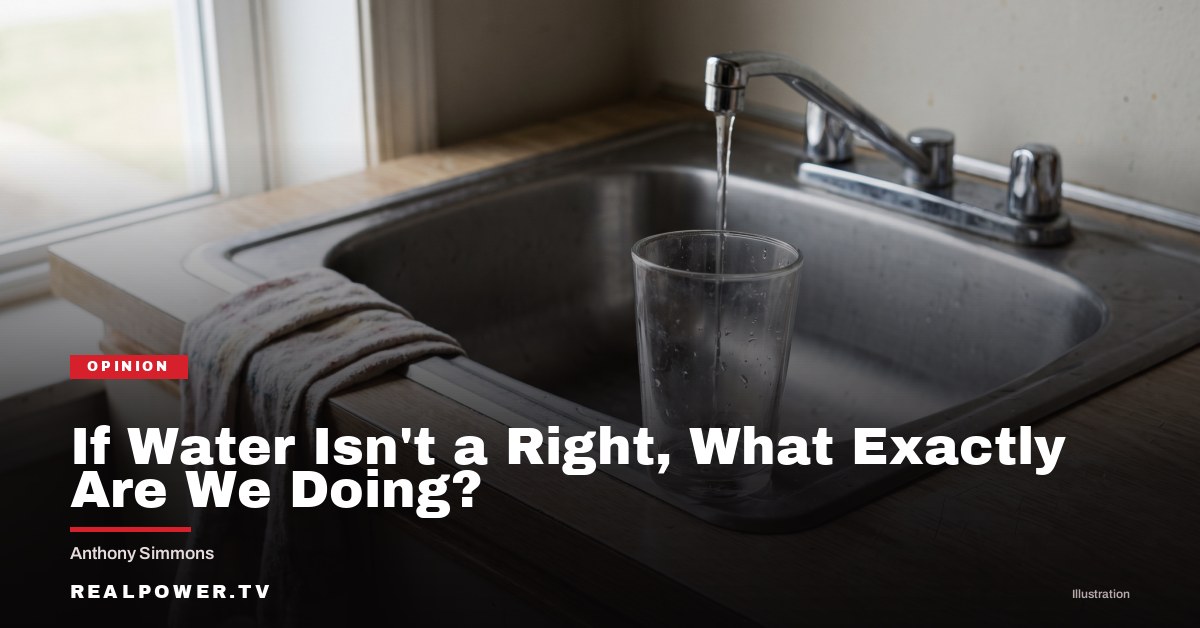
If you live in the United States and turn on your kitchen faucet, the water shouldn’t poison you. That should be one of the easiest things we agree on.
If I Can’t Drink It, Why Am I Paying the Same Bill?
There’s another part of this conversation that makes absolutely no sense to me. The bill still comes. Imagine being told the water coming into your house isn’t safe to drink. Now imagine opening your mailbox and finding your regular water bill.
No discount.
No refund.
No apology.
Pay up.
What exactly am I paying for?
Part of that bill supports the infrastructure and treatment necessary to provide usable water. If the government or utility fails to provide that service safely, residents should receive automatic credits or refunds.
If I ordered food at a restaurant and you told me it wasn’t safe to eat, you wouldn’t expect me to pay full price.
Why should water be different?
And bottled water and certified filters shouldn’t become another expense families have to absorb. If a public system fails, government should provide safe alternatives until independent testing establishes that the water is safe again.
Somebody Has to Be Accountable
We also need accountability with teeth. When water infrastructure fails because of an unavoidable emergency, that’s one thing. When officials know people are being exposed to unsafe conditions and fail to act, that’s different.
There should be financial penalties. Residents should receive bill credits. State and federal governments should be required to intervene when local systems cannot provide safe water. And in extreme cases involving knowing or reckless misconduct, I believe individual officials should face civil and, where legally warranted, criminal consequences.
Because without accountability, what incentive is there to fix the problem before it becomes a catastrophe? We cannot wait until children are sick, national news cameras arrive and everybody suddenly discovers that the pipes have been failing for decades.
This Is Also About Race and Poverty
We also can’t pretend every community gets treated equally.
When failing infrastructure affects poor communities, Black communities, rural communities and places without enormous political influence, problems can linger.
That’s why clean water is also an environmental justice issue. But my principle is universal. I don’t care whether the poisoned faucet is in a majority-Black neighborhood in Mississippi or a poor white town in Appalachia.
Fix it.
Clean drinking water shouldn’t depend on your ZIP code, income, race or political power.
What Does Government Actually Owe Us?
Some people will respond that clean water isn’t in the Constitution and that the Constitution primarily restricts government rather than promising citizens government services. What should a modern government owe its citizens?
I believe that in a country as wealthy as the United States, every person should have meaningful access to healthcare, clean water, sanitation, safe infrastructure, education and emergency services. And I’m willing to pay taxes toward making that possible. The United Nations recognized safe and clean drinking water and sanitation as a human right in 2010. So if America’s current laws don’t adequately guarantee it, change the laws.
I’m not angry at judges for interpreting the Constitution that’s in front of them. I’m angry that lawmakers can hear that clean drinking water isn’t constitutionally guaranteed and respond with anything other than: then we need stronger protections.
Are We Going to Privatize Everything?
This is where my concern becomes bigger than water. I increasingly feel like we’re moving toward a world where everything becomes a product.
Healthcare.
Education.
Housing.
Water.
Things necessary for human existence increasingly become another bill.
And I wonder where that road eventually ends. If water becomes something available based on what you can afford, what’s next?
Air?
That sounds ridiculous. I hope it always does. Because I don’t want to live long enough to watch breathing become another subscription.
America doesn’t need another slogan about being the greatest country in the world.
Show me.
Show me greatness in Jackson.
Show me greatness in rural America.
Show me greatness on reservations.
Show me greatness in every forgotten neighborhood where people pay taxes and water bills just like everybody else.
Build the rockets. Develop the AI. Explore Mars. Help people overseas. Do all of it.
But before America saves the world, make sure an American child can walk into their kitchen, turn on the faucet, fill a glass and drink it without their parents wondering whether that water will hurt them.
That shouldn’t be radical.
That shouldn’t be political.
That shouldn’t even be controversial.
It’s water.
And if the greatest country in the world can’t guarantee its people that, maybe it’s time we reconsider what we mean when we call ourselves great.
— Anthony Simmons
REAL POWER.TV
The Story Runs Here First.
Cleveland’s Black digital newsprint. Who holds power here, who is losing it, and what the moves mean before anybody gets around to explaining them to you. Free, straight to your inbox.