Cleveland Clinic Workers Walked Out. The Orchestra Followed. Your Healthcare Bill Is Next.
Let me tell you what this whole run of strikes is really about, because it’s not just about money. It’s about who this city decides is worth saving fast, and who it lets stand out there in the cold. And once you see it that way, you can’t un-see it.
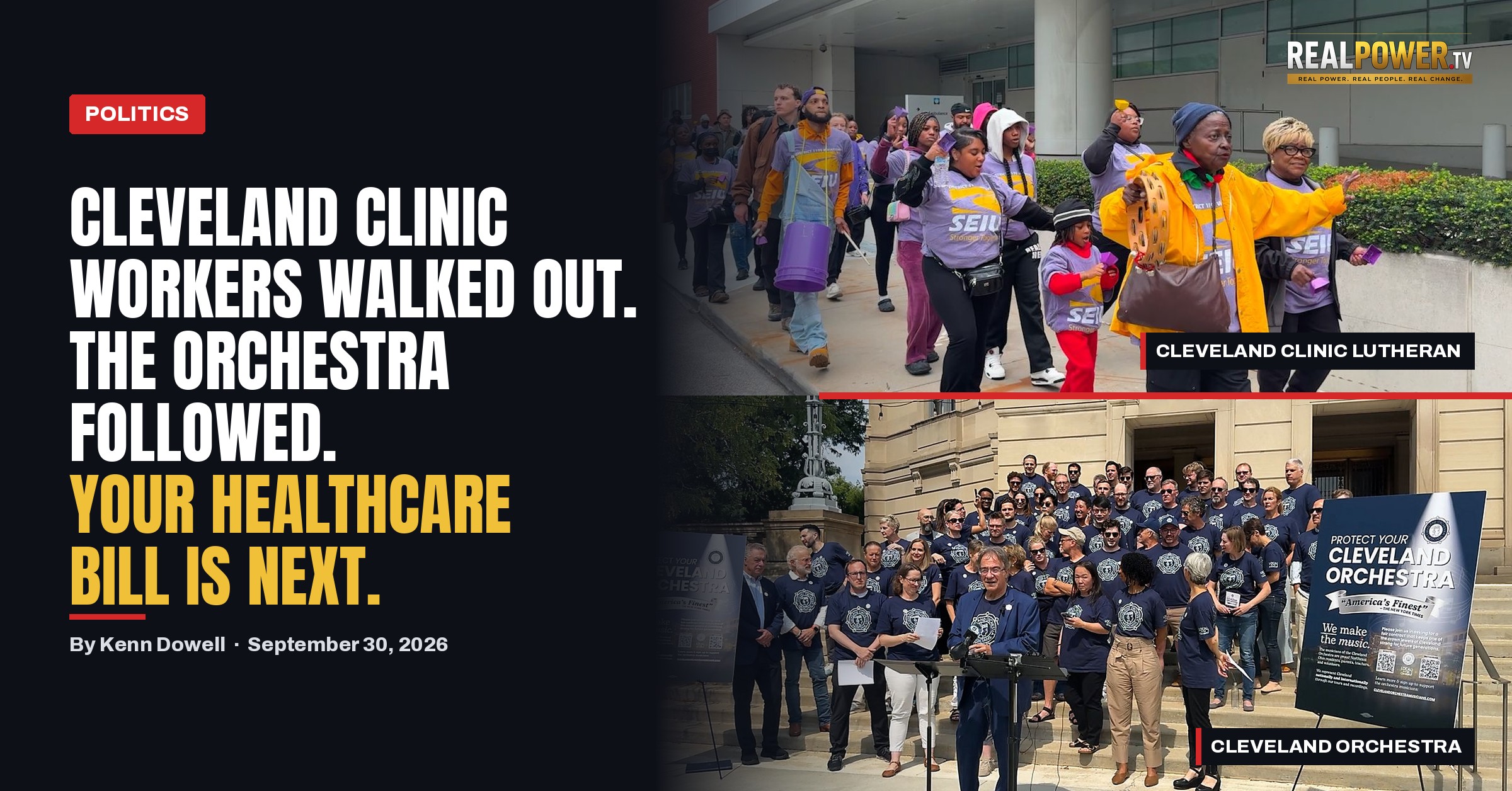
It started at noon on a Wednesday, when about 200 caregivers walked off the job at Cleveland Clinic Lutheran Hospital on West 25th. Nursing assistants. The STNAs. The people who clean the rooms, run the laundry, and keep the whole building breathing. They’d been bargaining since February. Their contract ran out in April. The fight is over what they pay for their own health insurance — and the hospital wanting to stop bargaining over that insurance at all.
The ones who got out quick
Two days later, the musicians of the Cleveland Orchestra set their own strike. And here’s the update: it barely lasted. Three days on the line, and by September 27 they had a new three-year contract and were headed back to Severance Hall. One of the fastest resolutions of the whole bunch.
The library moved just as quick. The Cleveland Public Library’s roughly 400 union workers had bargained for nearly a year, set a strike date, and at the eleventh hour management came to terms — an average 15 percent raise over three years, 5 percent back pay, a ratification bonus. Set a date, made it real, made management believe it. That’s the game, and they ran it right.
Now let me be clear about something, because I don’t want to be misheard. I’m glad the orchestra settled. I’ve got a few families right on my own street who play — in the Cleveland Orchestra and in other orchestras around here. These are my neighbors. Good people, serious about their craft, and they were lucky to get theirs done fast. I’m not mad at that. Shout-out to them.
And I’m not anti-arts. Never have been. I was one of the people who helped get the arts and culture levy started here in Cuyahoga County — the cigarette-tax money that’s kept music and theater and museums alive in this town for almost twenty years now, the one voters renewed again just last year. The arts matter. They feed a city’s soul. I believe that.
The ones still on the line
But here’s what’s eating at me. We always seem to find the money for the music. We dig it out, we protect it, we put it on the ballot and we pass it. And I’m proud of that. So why is it that the jobs that come to your rescue when your body fails you — those are the ones left standing on the corner with a picket sign and no deal?
Think about what an STNA actually does. When you’re sick and you can’t get up, they get you up. When you mess yourself because the illness took that from you, they clean you and they don’t make you feel less than a person while they do it. They hold onto your dignity when you can’t hold it yourself. That is holy work. And as of this writing, the caregivers doing it at Lutheran are still out there on West 25th, still without a contract, while the violins are already back in the pit.
I’m not putting one against the other. I’m telling you to notice the pattern. The jobs that got rescued quick sit higher up. The jobs still on the line — the aides, the housekeeping, the laundry, the lower-tier work — are, in this town, done mostly by Black folks and working people who don’t have a famous stage behind them. Same city. Two very different speeds.
Follow the money
And don’t let anybody tell you the money isn’t there. Cleveland Clinic posted $913 million in operating income last year, up from $276 million, and finished 2025 sitting on $16.8 billion in cash and investments, by its own accounting. You cannot look at that number and tell a laundry worker to tighten her belt.
The squeeze on top is real, I’ll give them that. Family health coverage through a job now runs almost $27,000 a year, per KFF, with the worker paying about $6,850 of it straight out the check — and premiums have climbed three years running. Washington poured gas on it: the One Big Beautiful Bill Act cut $911 billion out of Medicaid over the next decade, and a Public Citizen report flagged nine Ohio hospitals at risk because of it. That’s real pressure. But real pressure on a $16.8 billion balance sheet is still a choice about who eats it. And they keep choosing the person at the bottom.
This is bigger than Cleveland
And it’s not just us. Down in Akron, METRO transit workers voted a healthcare deal down 294 to 2 and authorized a strike 269 to 1. When 269 out of 270 people agree on anything, somebody at the top misread the room.
When 269 out of 270 people agree on anything, somebody at the top misread the room.Kenn Dowell
Cleveland-Cliffs, headquartered right here, is at the table with the Steelworkers with a deadline breathing down its neck. Across the country, healthcare workers alone have struck more than 20 times this year. And look at the times we’re living in — gas creeping back up, groceries higher every week, everything just a little harder than it was last year. When the cost of living climbs and the paycheck doesn’t, people stop asking nice. That’s why you’re seeing more picket lines, and that’s why you’re going to see more before this is over. This is the season of the strike, and it’s only getting started.
This is what your vote is for
So why does a labor fight sit in the politics section? Because the squeeze is written in Washington and Columbus, and the bill gets handed out right here. Congress voted the Medicaid cuts. The legislature voted on the library’s money. Every one of those decisions has a name attached, and every one of those names answers to voters — to us, if we show up.
You’re going to hear a whole lot about the cost of living between now and November. Here’s where it actually gets decided: in a bargaining room, over a line in a benefits package most folks never read, backed up or abandoned by the people we put in office. This is the election where we make that connection and act on it. Register, vote early, and hold every name on that ballot to one question — when the working people in this county set a date and stood on that line, whose side were you on?
The orchestra’s back at Severance Hall, and I’m glad. Now let’s bring that same energy, that same speed, that same city-wide will, down to West 25th Street for the folks who clean us up when we can’t. They kept our dignity. It’s time we kept theirs.
Kenn Dowell is the founder and publisher of RealPower.TV and CEO of Strategic Resources Consulting. Join RealPower.TV to get every edition.