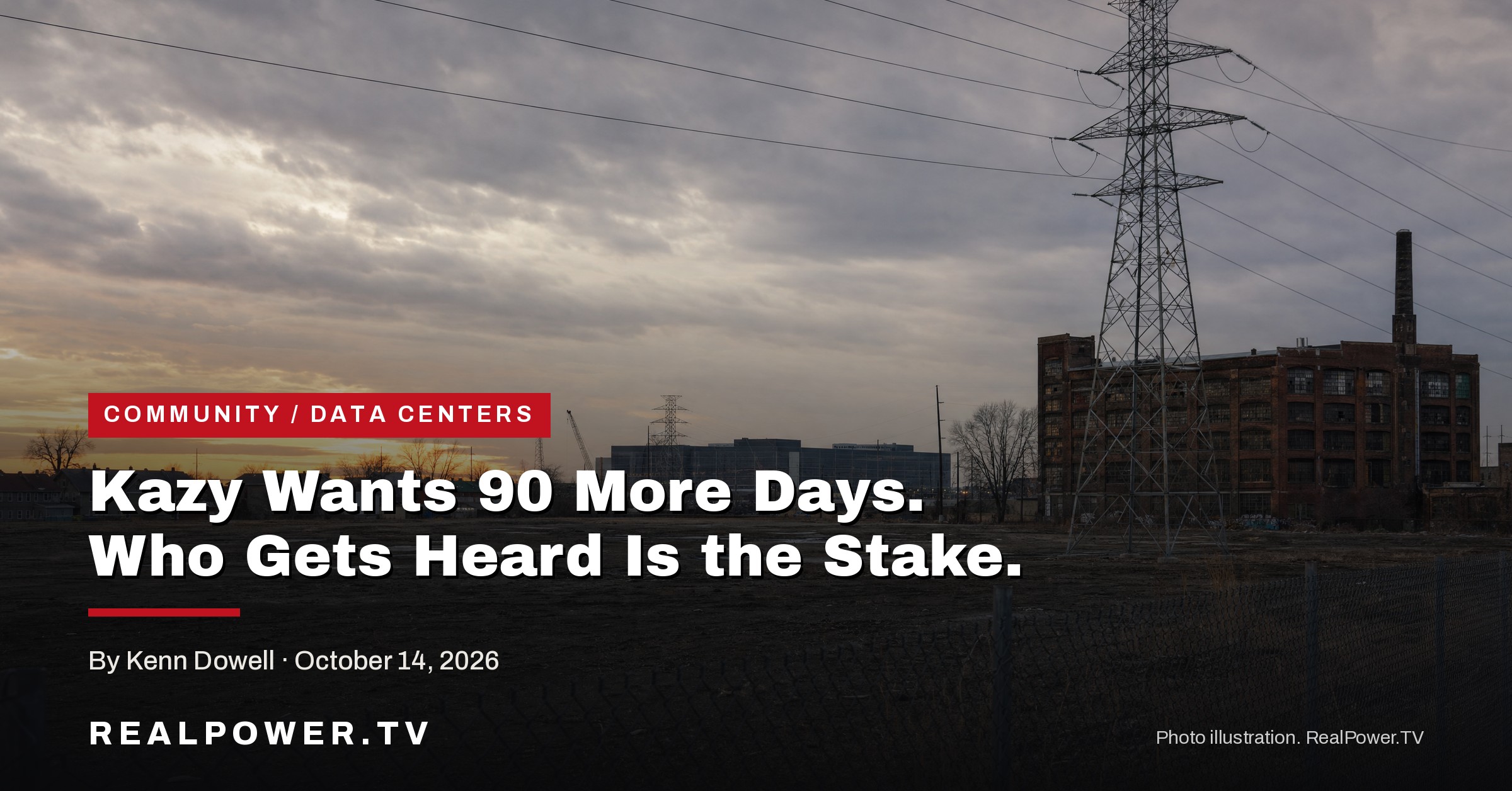
Brian Kazy Moves to Extend Cleveland’s Data Center Pause. The Next 90 Days Decide Who Gets Heard.
Community / Data Centers — REAL POWER.TV
My read on Nick Castele’s reporting for Signal Cleveland, and what we already know about Cleveland’s pause on data centers. Council is moving to buy three more months. Residents should spend every day of it in the room.
Cleveland just found out the clock on data centers is about to get reset. The question is whether we use the extra time, or let somebody else use it on us.
Credit where it is due. Signal Cleveland broke this. Nick Castele reported it in his Weekly Chatter column on October 12, and you should read his full story at Signal Cleveland. What follows is my read on his reporting, plus what RealPower.TV has already reported on this fight. Shout-out to Castele and the Signal team for staying on it while a lot of folks treated it like yesterday’s news.
Here is what Signal reported. Councilman Brian Kazy, who chairs Council’s Utilities Committee, is moving legislation to extend the city’s pause on data centers by about three more months.
Kazy’s reason is plain. The city needs 90 more days, he told Signal, “to assure that we get this thing right.”
Now here is my take. Take him at his word. Then ask the next question. Right for who?
Here is where the power sits. This summer Council put a temporary stop on new data center projects so City Hall could write rules for an industry that did not exist in our zoning code a few years ago. The AI boom is driving all of it. These buildings eat electricity and water on a scale most of us have never had to think about, and the companies building them shop for cities the way you shop for a used car. They want the cheapest land, the friendliest rules, and the least noise from the neighbors.
We already know what happens when the neighbors find out late. Earlier this year Lakeland Equity Group went after a permit for a $1.6 billion, 35-acre data center in Slavic Village. The city rejected that application. Council put the pause in place. Slavic Village got a breather, not a guarantee. Nothing written yet says that site, or one like it on the East Side, can’t come back with a better lawyer and a nicer brochure.
That is why these 90 days matter more than the first round did.
Kazy has done the visible work. He convened three public meetings on data centers, and he and other council members toured two local data centers. He told Signal most of the people he heard from oppose the giant “hyperscale” centers, the ones that need massive power to run artificial intelligence. He drew a line between those and the small and medium facilities that are part of the everyday internet.
That line is the whole fight. Write it in the wrong place and a hyperscale project walks through the door marked “medium.”
In our Watch section this week, I sat down with Jade Davis of BRITE Energy Innovators. She put the Slavic Village proposal at 150 megawatts of hyperscale demand. She was blunt about the light bill fear too. When people say a data center came to town and their bill went up, she said most of that comes back to one thing: no regulatory structure. And then she said the line every resident should hold onto. Here, she said, “the Black community actually controls a lot of government levers.”
Read that again. Zoning, permits, the power and water hookups, the tax deals. Every one of those runs through a public decision, and every public decision is a place where a neighborhood can make demands.
Watch the full conversation with Jade Davis right here on RealPower.TV.
So what do residents do with 90 days?
First, stop waiting to be invited. The public meetings Kazy held were real, and the people who came made a difference. The teacher who stood up and talked about power outages put the grid on the record. The next round of meetings is where the rules get their teeth or lose them. If your block is anywhere near an industrial site, you are in this.
Second, demand specifics in the code, not promises in a press release. How much power can one building pull before it needs a special vote? Who pays when the grid needs upgrades, the company or the ratepayers? How much water, and from where? What does the neighborhood get in writing, jobs with real hiring numbers or just a ribbon cutting? Where does the buffer go between a server farm and somebody’s porch? If those answers are not in the law, they are not commitments. They are conversation.
Third, watch who shows up for the other side. Developers, utilities and business groups are going to spend these 90 days in meetings most of us never see. That is not a conspiracy. That is how the game is played downtown. Our answer is to be in the room too, with a list of asks and the numbers to back them up.
And here is the national piece nobody should miss. Look at the history of who got the highway, the landfill and the plant the last time somebody called it progress. Black and working-class neighborhoods carried the burden while the benefit went somewhere else. The residents at those public meetings asked the same question out loud. Cleveland gets to decide whether data centers are another round of that, or the first time we write the rules before the trucks show up.
I have sat in enough rooms to know how this ends when the community is not organized. The rules get written by the people who were paying attention. Everybody else reads about it afterward.
We are paying attention. RealPower.TV will track this extension from introduction to vote, name every council member’s position when it is on the record, and bring the residents’ questions straight to the people holding the pen.
Castele’s reporting tells us what City Hall is planning. Jade Davis tells us where the levers are. The part that’s left is ours.
Ninety days. Use every one of them.
Editor’s note: This column is Kenn Dowell’s commentary on reporting by Nick Castele of Signal Cleveland, published October 12, 2026. Read Signal Cleveland’s original story here. Details on the Lakeland Equity Group proposal and the public hearings come from RealPower.TV’s earlier coverage. Jade Davis’s remarks are from her RealPower.TV interview.
REAL POWER.TV
The Story Runs Here First.
Cleveland’s Black digital newsprint. Who holds power here, who is losing it, and what the moves mean before anybody gets around to explaining them to you. Free, straight to your inbox.