Demystifying Credit Utilization: The Hidden Lever in Your Credit Score

Business and Finance / Credit — REAL POWER.TV
When people talk about building credit, the conversation almost always drifts toward paying bills on time. Payment history matters, of course. But treating on-time payments as the only tool in the box is like owning a sports car and never shifting it out of first gear. If you want to maximize your borrowing power—whether you are preparing to buy a home in an affordable market like Cleveland or positioning yourself for real estate investing—you have to understand the silent driver sitting right beside your payment history: credit utilization.
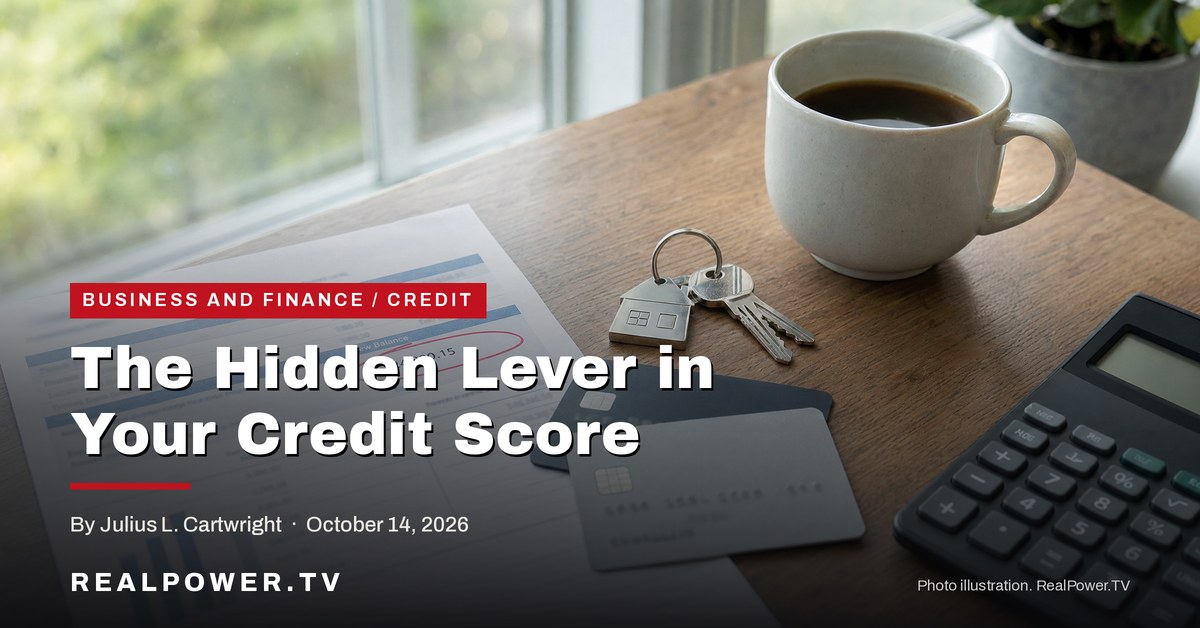
Credit utilization is simply the ratio of your current revolving credit card balances to your total credit limits. If you have a total credit limit of $10,000 across all your cards and your combined balance sits at $3,000, your credit utilization is 30%.
Lenders and scoring models love this metric because it acts as an immediate indicator of financial stress. High utilization signals that you may be overextended, even if every single payment has arrived on time. Conversely, low utilization tells the algorithm that you manage credit responsibly without relying on it to survive.
The 30% Myth and the 10% Reality
For years, the conventional wisdom has dictated that keeping your utilization below 30% is enough to keep your credit score healthy. While 30% is a safe ceiling, it is not the optimal target if you are trying to qualify for the best mortgage rates or secure high-tier financing.
The scoring algorithms used by top-tier lenders give the strongest weight to individuals who keep their reported utilization in the single digits—ideally between 1% and 9%. Zero percent utilization, surprisingly, can sometimes penalize your score because the system likes to see active management of revolving lines. Showing a tiny, actively paid-off balance demonstrates that you know how to use credit as a tool rather than avoiding it entirely.
The Timing Trap: Statement Dates vs. Due Dates
Here is the detail that trips up even financially savvy consumers: paying your bill by the due date does not automatically guarantee a low credit utilization score.
Credit card issuers typically report your balance to the major credit bureaus on your statement closing date—which is usually a few weeks before your actual payment due date. If you rack up a $4,000 balance on a $5,000 card during the month, and your statement closes on the 15th showing that $4,000 balance, the credit bureaus record an 80% utilization rate for that month—even if you pay the entire balance off in full on the 25th.
To manipulate your utilization in your favor, you have to shift your payment habits. Instead of making one large payment on the due date, break it into micro-payments throughout the month, or pay the balance down before the statement closing date hits.
Why This Matters for Your Financial Future
When you are looking to step into the housing market, your credit score dictates your interest rate. A difference of even 50 points on a mortgage can cost you tens of thousands of dollars over the life of a thirty-year loan.
Mastering credit utilization is one of the few levers you can pull that yields rapid results. Unlike payment history, which takes years of consistent behavior to build, credit utilization updates every single month as soon as your issuers report new data. Lower your balances relative to your limits today, and you could see a meaningful bump in your score by your next billing cycle.
Credit is not a mystery, and it is not a fixed measurement of your worth. It is a system of rules. Once you learn how the rules work, you can stop letting the algorithm dictate your purchasing power and start using it to build the future you actually want.
Mastering your credit utilization is only the first step in taking control of your financial architecture. Knowing how the scoring algorithms operate gives you the leverage, but building long-term wealth requires putting that power into motion.
This is where Equity Smart is the New Cool changes the game. We provide the practical frameworks, structural education, and guidance needed to dismantle financial barriers and position you as a serious contender in the market. But knowledge alone is not enough—it requires execution alongside a community that refuses to stay on the sidelines.
By joining Equity Movement 247, you plug into a relentless network dedicated to turning everyday consumers into active investors and homeowners.
Stop letting the algorithm dictate your purchasing power and start building an asset that lasts. The system is learnable, the doors are open, and your financial independence starts today.
REAL POWER.TV
The Story Runs Here First.
Cleveland’s Black digital newsprint. Who holds power here, who is losing it, and what the moves mean before anybody gets around to explaining them to you. Free, straight to your inbox.