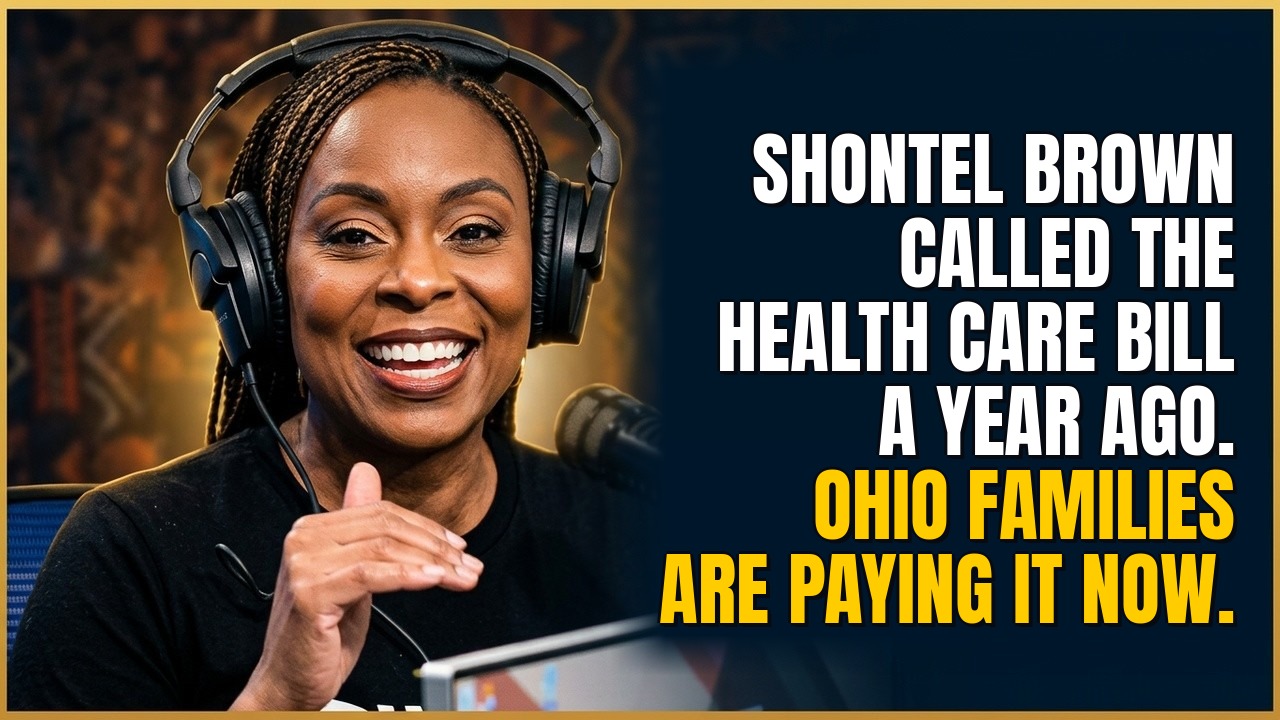
Shontel Brown Called the Health Care Bill a Year Ago. Ohio Families Are Paying It Now.
Last October the government had been shut down about a week, and Congresswoman Shontel Brown walked up in our studio on a Tuesday — early voting day — and got straight on the mic. No handlers, no script, no dancing around it. She came to break down a fight most folks couldn’t even see yet. And check this: somebody told me that same week it didn’t even feel like the government was closed. That’s the trick right there. The stuff that costs you the most is usually the stuff they keep the quietest.
She told us exactly what the fight was about. A year later, every word of it is showing up on people’s bills.
The cut nobody got a say in
Brown started with the law the Republicans dressed all the way up and called the One Big Beautiful Bill. She gave it a realer name. “The big ugly law,” she said — signed on the Fourth of July, no Democrats in the room, no negotiating, none of that.
“It’s the largest health care cut in our nation’s history,” she told us. Medicaid. Medicare. The Affordable Care Act. The tax credits that keep regular working families covered. All of it on the chopping block at the same time.
That’s what the shutdown was really about. The Democrats said they weren’t reopening the government until those cuts got rolled back and the credits got extended, and Brown laid the math out so plain anybody could follow it. Republicans run the House and the Senate. But over in the Senate they had 53 votes and needed 60 — which means they needed seven Democrats to come walk across the aisle. “We don’t rubber stamp,” she said. “If you want our votes, you’re going to have to come to the table and talk to us.” Simple as that.
What she told us it would cost
Then she got specific, and this is the part that should’ve made everybody sit straight up. For some families, premiums, deductibles and co-pays were about to jump as much as $700 a month. And she made real sure we heard her right. “An increase,” she said. “Not the cost — an increase of $700 a month.”
Sit with what that does to a household. You’re a family staring at $700 more for insurance or keeping the lights on and a roof up — you’re paying the rent. Every time. So people drop the coverage. More folks get sick, the ERs back up, and here’s the part nobody tells you: it don’t stay with the people who lost their plan. “Insurance companies are going to spread that love around,” Brown said. “That’s going to impact all of us.” Everybody’s bill goes up. Everybody.
And she put real numbers on it — more than 20 million people across the country, 500,000 right here in Ohio, and 38,000 in her own district. “I refuse to let 38,000 people in my district be hit with such a significant increase when costs are already high,” she said. That’s a person who knows exactly whose name is on the line.
“An increase. Not the cost, an increase of $700 a month.”Rep. Shontel Brown, Oct. 7, 2025
And Dr. Heather E. Burton said the thing folks sitting comfortable always forget: “You don’t realize the benefits of health care until you don’t have it.”
And then it came true
The shutdown dragged on 43 days — the longest in the history of this country. It ended back in November, and it ended without the health care extension the Democrats were holding out for. They didn’t get it.
So the enhanced tax credits ran out at the end of 2025, right on schedule. And KFF — the people who actually track this — say the average person on an ACA plan watched their monthly payment jump 58 percent this year. From $113 to $178. More than a million people just stopped signing up. Millions more quietly fell off. And the only reason the number ain’t worse is that families downgraded to cheaper plans with deductibles up to the sky, or walked away from coverage altogether. That’s not relief. That’s people getting priced out and being told to call it a choice.
And it’s the same squeeze sitting on the front page of this same edition. Lutheran’s caregivers out on the picket line over what they pay for their own insurance. The orchestra fighting over that same line in their contract. Brown told you a year ago exactly where this was coming from. She wasn’t guessing, and she wasn’t playing.
Now the map fight
The second half of that hour, we got into the real chess — who gets to hold onto power when the bill comes due.
Last fall, Ohio Republicans were out here redrawing the congressional map in the middle of the decade — Texas doing the exact same thing on the president’s say-so. Brown didn’t dress it up for nobody. “If you can’t beat them, cheat them,” she said. And she reminded everybody what those redistricting reforms Ohio voters passed were supposed to be about in the first place: “Politicians do not get to pick their voters. The voters get to pick their politicians.” Read that one twice.
On October 31st the Ohio Redistricting Commission passed a new map, unanimous. And according to the Ohio Capital Journal, they drew it to favor Republicans in 12 of 15 seats — up from a 10-and-5 split. Two Democratic districts, including Marcy Kaptur’s, got pushed toward the Republicans. Brown’s own 11th District came out stronger, right around 78 percent Democratic. That’s a safe seat for her — and a harder road for the Democrats standing right next to her. Like Senate Minority Leader Nickie Antonio put it: not the map Ohioans deserve, but a disaster we barely dodged.
And Brown didn’t act like that seat belongs to her. “The seats belong to the people to start with,” she said. She pointed all the way back to Louis Stokes, who fought so representation actually looked like the people it served. Stephanie Tubbs Jones carried it after him. Marcia Fudge carried it after her. That’s a lineage. You don’t play with that.
Fall in line, fall in love
She left us with a line I’ve been repeating ever since. “Republicans fall in line and Democrats fall in love.” One side shows up and votes together on the main thing, every single time. The other side is still arguing about the color of the banana while the bill’s already passing.
That’s the lesson a year later. The cut passed. The credits lapsed. The map got redrawn. Every one of those was a vote — with names attached — and every one of them got announced way ahead of time. Brown told us in October. The people paying attention had a whole year to get ready. The ones who weren’t? They’re finding out right now, on their premium notice.
So let me talk to you straight, the way I would on the air. Open enrollment starts November 1st. Pull your plan up and do the math before you hit renew. And the next time somebody in office tells you what a bill is fixing to cost you — believe them the first time.
Kenn Dowell is the founder and publisher of RealPower.TV and CEO of Strategic Resources Consulting. Join RealPower.TV to get every edition.