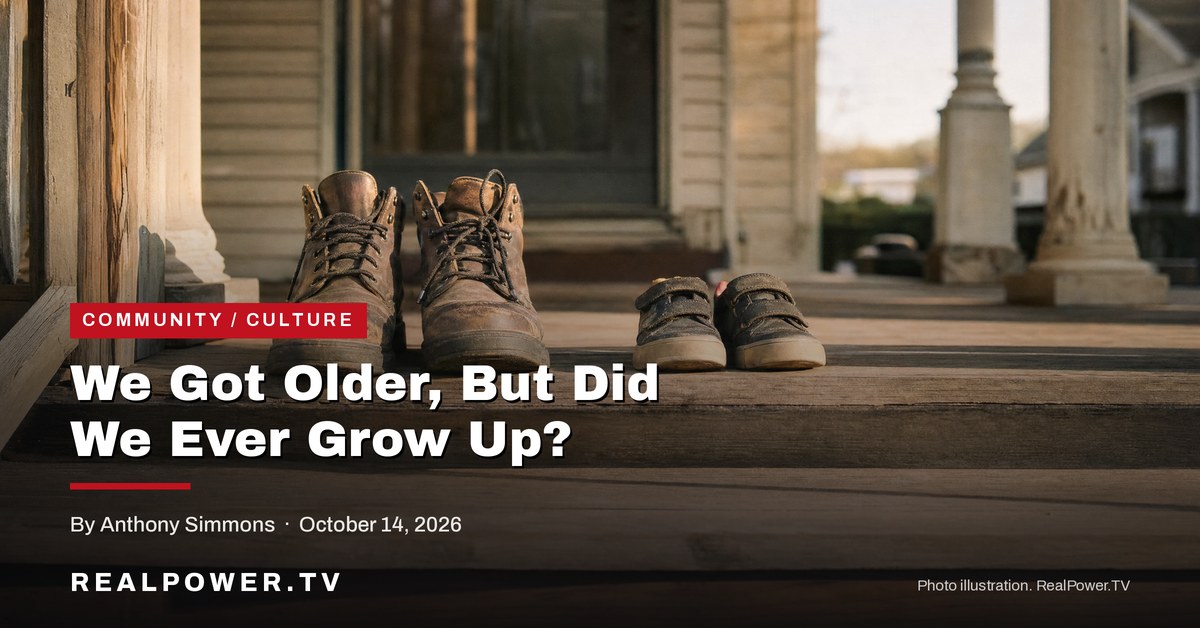
We Got Older, But Did We Ever Grow Up?
Community / Culture — REAL POWER.TV
Arrested Development in the Black Community
I recently found myself thinking about the television series Arrested Development. For those who haven’t watched it, the show follows the Bluth family, a group of adults who seemingly refuse to grow up. They lie, argue, avoid responsibility, and constantly make decisions that leave their family in worse situations. It’s a hilarious show, and I genuinely recommend watching it.
Something interesting happens as the series progresses. The younger characters get older, and slowly, they begin making the same poor decisions as the adults who raised them.
The dysfunction becomes generational, while watching, I couldn’t help but think about some of the things I’ve witnessed within my own family and the Black community.
I’m watching people in their forties and fifties arguing on Facebook like teenagers. I’m watching grown adults fighting people their own age and sometimes people young enough to be their children. I’m watching people prioritize immediate gratification without considering what their decisions mean for tomorrow.
And I keep asking myself:
When did getting older stop meaning growing up?
The Difference Between Age and Maturity
Somewhere along the way, I believe we’ve confused adulthood with maturity.
Having children doesn’t automatically make you mature. Neither does having a job, paying bills, or reaching your forties.
To me, maturity means making difficult decisions. It means understanding that sometimes you have to go without because you simply don’t have it. It means sacrificing something you want today because you’re building something better for tomorrow.
Most importantly, it means understanding that life is bigger than your immediate wants and emotions.
But we live in an era of instant gratification.
I want it now.
I deserve it now.
I’ll worry about tomorrow when tomorrow comes. Michael Beasley once said that “If tomorrow was a place we had to go to, you know how many people wouldn’t make it” this quote stuck with me because how lucky are we that we get to see tomorrow. We treat tomorrow like it isn’t a destination.
That mentality is dangerous when you’re responsible for raising another human being, because children don’t just listen to what we tell them. They watch how we live. If we settle disagreements through public humiliation, arguments, and violence, why are we surprised when our children struggle to resolve conflict? If we refuse accountability, why would they embrace it?
We cannot continue demanding maturity from children while refusing to demonstrate it ourselves.
We Lost a Blueprint
I also believe this problem is connected to a larger historical reality.
Black America has experienced tremendous losses in leadership.
Malcolm X. Martin Luther King Jr. Fred Hampton. Medgar Evers. Patrice Lumumba. Different men, different philosophies, different approaches to liberation. But each represented a vision of Black political power, self-determination, or collective advancement. Their deaths weren’t just losses of individual lives. They interrupted movements, organizations, relationships, and possibilities. We also know that government agencies actively surveilled and disrupted Black political organizations. That history is documented.
But what happened to the leadership blueprint afterward?
Who filled the void?
Somewhere along the way, I believe we began confusing popularity with leadership. We started looking toward entertainers, athletes, rappers, and celebrities for answers to questions about Black liberation.
And I have a problem with that.
Not because entertainers cannot be leaders, but because being famous doesn’t automatically mean someone understands community development, political organizing, or collective responsibility. I’ve criticized Jay-Z before for what I see as the contradiction between promoting Black empowerment and operating within a system that rewards individual wealth accumulation.
That larger contradiction still bothers me.
When did becoming rich become the same thing as becoming free?
There’s another uncomfortable truth.
Many people want to live like their favorite athletes and entertainers without understanding what it takes to reach that level.
We see the cars. The jewelry. The vacations. The designer clothes.
We don’t see the athlete pushing through exhaustion, dealing with cramps after hours of training, or sacrificing personal time to improve. We don’t see the musician working through sleepless nights, failed projects, rejection, and years of uncertainty. We see the reward and convince ourselves we’re entitled to the same outcome. But how many of us are willing to sacrifice even one hour of sleep to pursue something meaningful? How many are willing to give up an expensive weekend because that money needs to go toward a larger goal?
We want greatness without discipline. And that’s not how greatness works.
Entertainment Is Not a Blueprint for Living
I also believe media has influenced what we’ve come to accept as normal. From MTV and BET to today’s reality television and social media platforms like Zeus and Kick, conflict has become entertainment. Look at the popularity of shows built around public arguments, cheating, betrayal, and physical confrontations. Platforms like Zeus have built audiences around some of these spectacles. But those moments don’t represent the entirety of Black life. We are teachers, engineers, organizers, artists, parents, entrepreneurs, and community leaders. We are people who sacrifice quietly every day. Yet the most outrageous behavior often receives the most attention. And social media makes it worse.
A thoughtful conversation might receive a handful of likes. A public argument can travel across the internet. We have to ask ourselves what happens when dysfunction becomes profitable, and more importantly, what happens when young people begin mistaking that dysfunction for adulthood?
Criticism Can Come From Love
I struggled with writing this article, because I love my community.
There are already enough people criticizing Black people and Black culture. I didn’t want to become another voice punching down on my own community.
I believe in our intelligence, creativity, resilience, and potential, but I’ve also come to understand that loving something doesn’t mean refusing to challenge it. We cannot heal wounds we refuse to acknowledge. Historical oppression matters. Economic inequality matters. Institutional discrimination matters. The deliberate disruption of Black organizing matters. I remain concerned about the influence of people whose public language of empowerment doesn’t match the consequences of their actions.
Those realities cannot become excuses for every decision we make. At some point, we have to examine what is within our control. We cannot control every political institution, media corporation, or wealthy celebrity, but we can control how we treat our children. How we resolve disagreements. How we spend our money. How we prepare for tomorrow. Lastly, how we respond when we’re wrong.
The system may have helped create the conditions, but we cannot keep asking the next generation to live with the consequences of our refusal to grow.
It’s Time to Lock In
I have spent years around political strategy and community leadership, including my work alongside Kenn Dowell and RealPower.TV. That exposure taught me that leadership isn’t always about being the loudest person in the room or having the largest following. Sometimes it’s about planning, organizing, sacrificing, and understanding the bigger picture. And that’s what I want us to return to.
We need more adults willing to think beyond themselves. More parents willing to examine what their children are learning from their behavior. More mentors. More accountability. More discipline. More people willing to build something that may not benefit them immediately. This is a pivotal time, and I believe Black adults need to lock in. Not because every Black adult is failing. Far from it. There are countless people doing the work every day without recognition.
Maybe the most disturbing thing about Arrested Development wasn’t that the adults never grew up. It was watching the younger generation begin to repeat the same mistakes. We spend so much time asking who will become the next Malcolm, the next Martin, or the next Fred Hampton. But perhaps we should spend more time asking whether we’re preparing the next generation to become leaders at all.
Because our children are watching us.
They’re learning what adulthood looks like. And if we don’t show them something better, we cannot be surprised when they become exactly what we showed them.
We got older.
Now it’s time to grow up.
REAL POWER.TV
The Story Runs Here First.
Cleveland’s Black digital newsprint. Who holds power here, who is losing it, and what the moves mean before anybody gets around to explaining them to you. Free, straight to your inbox.